


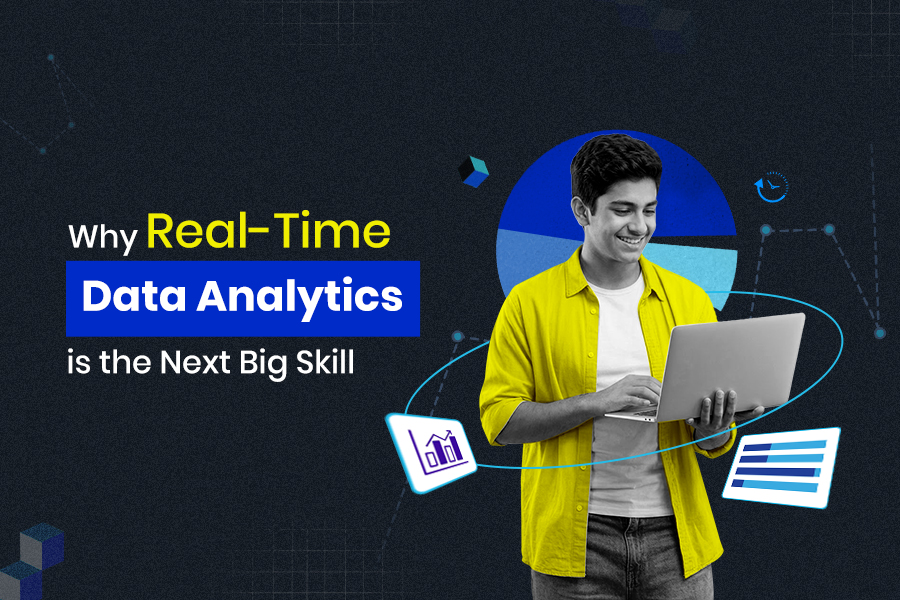
Why Real-Time Data Analytics is the Next Big Skill
Today’s data analyst is specialised in real-time analytics. This role involves using popular AI analytics tools, along with industry best practices, to provide businesses with near-instant insights. This results in rapid decision cycles based on up-to-the-minute data.
To give you some context, Statista reports that the total amount of data generated worldwide is expected to grow to 180 zettabytes by 2029.
This mind-boggling volume of data would need to be cleaned and interpreted by talented data specialists.
In fact, according to the World Economic Forum’s report, AI and big data are among the most in-demand skills of the future.

As you can see, healthcare is currently the sector generating around 30% of the world’s data volume, followed by other data-heavy industries like manufacturing, finance, and media.
This goes to show that a course in real-time data analytics can open up career opportunities in many sectors like ecommerce, banking and finance, retail, IT, marketing, and healthcare.
If you are a student who is planning to take a Data Analysis course, this guide will get you familiar with everything you can expect.
What is Data Analytics?
Data analytics is an efficient process carried out by professionals where they convert raw data into actionable insights, helping businesses reach their full potential.
Experienced data analysts collect business data and then proceed to clean, analyse, visualise and pull insights from it.
The entire data analytics workflow is supported and automated by AI, specifically tools like generative AI, Tableau AI, Power BI and Microsoft CoPilot.
What is real-time data analytics?
To enable real-time data analytics, continuously updated data streams are used to help businesses make instantaneous, context-aware decisions.
In the traditional process, data analysis involves historical data that is processed in batches, which results in a fair bit of latency.
In real-time data analytics, this latency is minimal, ensuring that data generation and data analysis happen in a continuous, immediate flow.
Industries that have time-sensitive functions, including ecommerce, finance, manufacturing, and logistics, are highly dependent on real-time data analytics.
What Skills Do Real-Time Data Analysts Need?

As data in the current scenario is dynamic (ever-changing), the analysis of that data needs to be similarly dynamic.
Because of this, data analysts are required to be skilled in handling live data streams and popular AI analytics tools.
1. Streaming Data Processing
Analysts need to process data streams in real-time, as opposed to static datasets.
They typically use tools like Apache Kafka or Spark Streaming to enable fraud detection, personalised user recommendations, synchronising database changes and so on.
2. Real-Time Database Knowledge
As a professional analyst, you would need to understand how real-time databases work.
This will help you handle, analyse, and showcase live data instantly, without delays, and extract insights within seconds.
You move beyond static data warehouses and get familiar with the mechanics of streaming data technologies.
3. In-Memory Computing
Analysts must be familiar with In-Memory Computing (IMC) because it enables real-time analytics and instant data processing.
IMC does this since it is designed to store data in RAM rather than traditional disk storage.
Through this technology, data analysts can significantly accelerate complex simulations, big data analysis, and predictive modelling. This shortens decision-making windows.
4. Streaming Analytics & SQL
In real-time systems, you use SQL or similar languages to query data (this involves using tools to process data in real time).
You would be using tools including Azure Stream Analytics and Apache Flink. These tools allow you to continuously run SQL queries on incoming data, so you can catch issues like failed transactions or traffic spikes as they occur.
5. Machine Learning (ML) & AI Integration
To conduct predictive analytics, you will need to be familiar with Machine Learning (ML) and AI integration.
Firstly, it allows you to effortlessly complete routine data tasks using automation. Plus, you can help you quickly extract hidden, complex patterns, especially within massive datasets.
6. Data Visualisation (Real-Time)
In workflows where rapid decision-making is required and delays are costly, it’s important to be familiar with data visualisation tools like Grafana, Tableau, and Power BI.
Since these tools offer live dashboard updates, they can monitor metrics as they happen or help you spot trends or issues immediately so you can act without delay.
Why Real-Time Data Analytics is the Next Big Skill
Now that you know the key real-time data analytics skills that professionals in this field require, it’s important to know precisely why they are in high demand.
1. Instantaneous Decision-Making
According to Salesforce, companies using modern data systems show 38% faster decision-making.
That improvement comes from removing delays in how data is processed.
In the background, variables like pricing, inventory, or campaigns get adjusted while the activity is live.
This is why analysts are expected to work with streaming data and systems that update continuously, not static reports that arrive after the situation has already changed.
2. Customer Experience Optimisation
When you open an app or website, the response you see depends on what the system knows about you at that exact moment. In 2026, customers expect companies to predict their needs before they ask.
The fact is that this is only possible when user behaviour is processed live.
So analysts need to work with continuously updating data to offer their customers relevant (not haphazard or outdated) recommendations, alerts, and personalised interactions.
3. Operational Efficiency and Automation
Companies are building systems with AI and machine learning that adjust operations automatically.
In fact, Fortune Insights reports that the real-time analytics market was valued at $890.2 million and is expected to grow rapidly at over 25% CAGR.
Of course, this requires high-quality, live data streams.
This is possible when analysts work on live pipelines and feed accurate data into automated systems without manual intervention.
4. Proactive Risk Management
It takes just a few seconds for fraudulent transactions to go through or even for operational failures to occur.
These red flags can be caught if analysts monitor data as it flows. Using streaming tools and processing frameworks, they are able to trigger responses (such as blocking payments or flagging accounts).
And, this is done before the problem grows larger or affects more users.
Planning On Enrolling In a Data Analytics Course?
There is no doubt that data analytics is a future-proof career choice. According to research by Markets and Markets, the global big data market is projected to increase from USD 324.59 billion in 2026 to USD 516.29 billion by 2031.
If you are considering joining this field, you will have a wide range of industries to choose from, as data is everywhere. As of early 2026, the entry-level data analysts in the U.S. typically earn an average salary of approximately $65,000–$70,000 per year. With experience, this can go much higher.
To get started, you can consider enrolling in the popular data analytics course from Webskitters Academy. You can expect complete technical training and hands-on experience from experienced professionals.
Speak to our dedicated counsellors to learn about the course details.
Frequently Asked Questions
What are the top 3 skills for data analysts?
You should focus on SQL, data visualisation, and basic statistics. These help you pull data, understand patterns, and explain your findings clearly to others.
Will AI replace data analysts?
No, AI will not replace you completely. It can handle repetitive tasks, but you still need to interpret results, ask the right questions, and explain insights.
Can ChatGPT do data analysis?
Yes, it can help you analyse data, write queries, and explain trends. But you still need to check accuracy and apply your own judgement.
Is there a high demand for data analytics?
Yes, there is strong demand right now. Companies rely on data to make decisions, so they need analysts who can work with data and explain results clearly.
Is data analytics a good career choice?
Yes, it is a solid career option. You get good growth, work across industries, and build skills that stay relevant as businesses depend more on data.
FAQ
-
1. What is an API?
An API is a set of rules that allows different software systems to communicate and share data.
-
2. Why are APIs important in web development?
APIs simplify integration, enable automation, and accelerate digital transformation for businesses.
-
3. What is the difference between REST and GraphQL?
REST uses fixed endpoints, while GraphQL allows clients to request only the specific data they need.
-
4. When should you use GraphQL over REST?
GraphQL is ideal for complex, dynamic data requirements requiring flexibility and efficiency.
What are alternatives to REST and GraphQL?
SOAP and gRPC are popular alternatives offering structured messaging and high-performance communication.

Ayan Sarkar
Ayan Sarkar is one of the youngest entrepreneurs of India. Possessing the talent of creative designing and development, Ayan is also interested in innovative technologies and believes in compiling them together to build unique digital solutions. He has worked as a consultant for various companies and has proved to be a value-added asset for each of them. With years of experience in web development, product managing and building domains for customers, he currently holds the position of the CTO in Webskitters Technology Solutions Pvt. Ltd.


I Want to Learn...
Related Posts
-

Deep Learning: Practices, Applications and Future
30th Jan 2025 -
-

-
-
Category

Subscribe to Our Newsletter
"*" indicates required fields